
Digitization Overview
We have a tendency to think that we are living in the late stages of a digital revolution. We see smartphones in every pocket and sensors on every assembly line, and we assume the work of digitization is mostly finished. But if you look closely at the data, you’ll find something much more interesting: we aren’t at the end of the journey; we are only at the 25% mark of the journey. According to a McKinsey report in early 2024, 89 percent of large companies have a digital transformation underway, yet they have captured only 31 percent of the expected revenue lift.
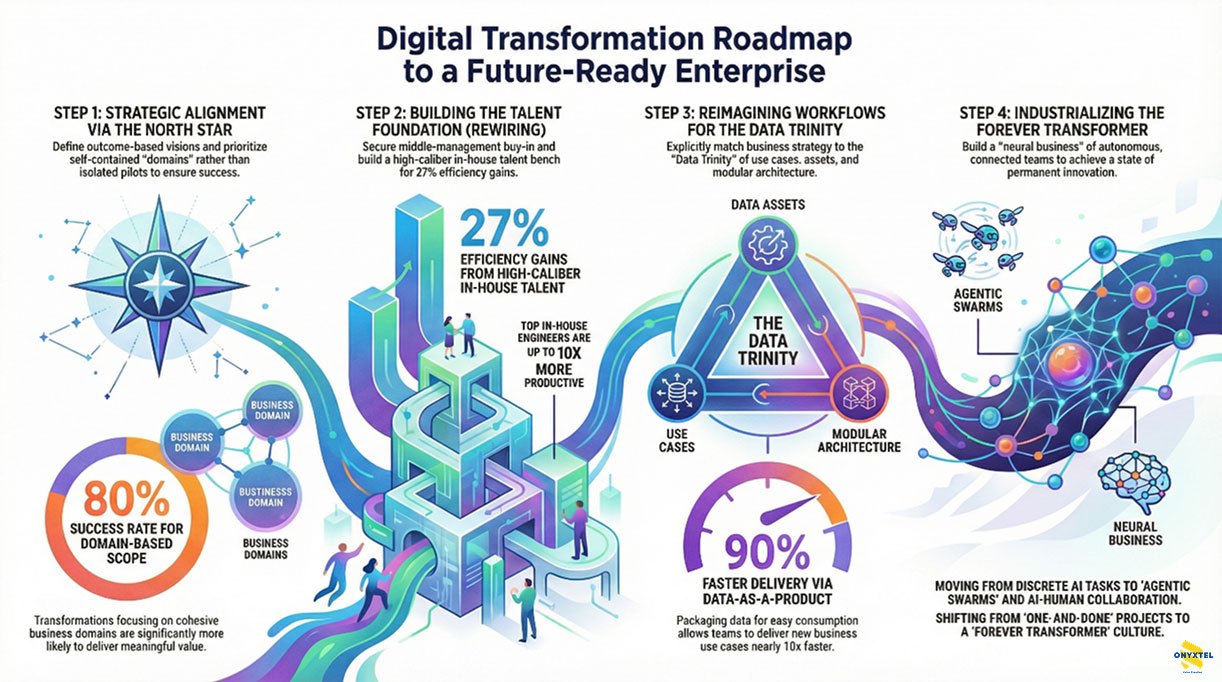
Here is the 4-step program to flip the odds of success to a commanding 80% or higher.

Step 1: Secure Strategic Alignment via the “North Star”
Success begins not with a tool, but with a “North Star” based on outcomes. Most companies fail because they spread resources too thinly across uncoordinated initiatives. According to a Harvard Business Review 2021 research, leaders instead adopt a domain-based approach, focusing on a subset of the enterprise that encapsulates a cohesive set of related activities. As many as 80 percent of successful interventions are based on re-anchoring scope toward these self-contained domains rather than isolated use cases. The goal is to pick “digitization battles big enough to matter and small enough to win”.
Step 2: Unfreeze the Middle and Own the Craft
The most significant development happens in the frontline or factory floor, not the server room. While three out of four executives claim to have leadership engagement, only one in three actually secures the buy-in of middle management. According to BCG case studies, this “frozen middle” must be unfrozen by involving them in the design so they see technology as a “team member” rather than a threat. Furthermore, you cannot outsource your way to excellence. McKinsey research has reaffirms that organizations must build an in-house talent bench strength; a top engineer is ten times more productive than a novice, and having a tech-savvy C-suite significantly increases the chance of ending up in the top quartile of performers.


Step 3: Reimagining Workflows for the “Data Trinity”
Transformation requires explicitly matching business strategy to the core set of high impact data which we can term as “Data Trinity”: important use cases, the data collection and analytics platform that power them, and the design & presentation layer that makes key data & insights accessible to users as well as management. Instead of bolting AI onto existing processes and call it an AI initiative, leaders reimagine end-to-end workflows. This evolution moves from discrete AI tasks to “agentic portfolio”—autonomous systems with skills and supporting capabilities that can plan and execute multistep business outcomes. Companies that treat data as an integral part of a curated project can deliver new use cases 90 percent faster and reduce the total cost of ownership by 30 percent, based on data points from a McKinsey research on Digitization best practices.
Step 4: Industrializing the “Evolve & Be Future Ready” Mindset
Digital transformation does not have one destination; it is a “forever journey” to increase competitiveness. The success of a program is actually the beginning of a fresh chapter where the organization masters the art of continuous innovation & improvement. This requires building a “rapid deployment units” where small, autonomous teams are connected to enable rapid adaptation. When companies invest in foundational capabilities across team and agile governance, they are nearly two times more likely to see revenue growth rates of 10 percent or higher based on a study published by McKinsey.

The Conclusion
The lesson here is simple – digitization isn’t a goal that you achieve by buying software and deploying it. It’s an evolutionary shift from “managing” to “orchestrating”. By 2040, the most competitive factories or business operations will be self-optimizing ecosystems where humans and machines/AI collaborate in a “virtuous but co-dependent cycle”. The question for the modern executive is no longer if they will digitize, but whether they have the courage to reinvent their entire organizational DNA before the “S-curve” of the old model inevitably flattens.