To achieve a seamless transition and realize tangible cost savings, we must move beyond a simple procurement exercise. This framework represents a disciplined, value-oriented methodology designed to mitigate operational risk while maximizing the Total Cost of Ownership (TCO) benefits over a 7-year horizon.
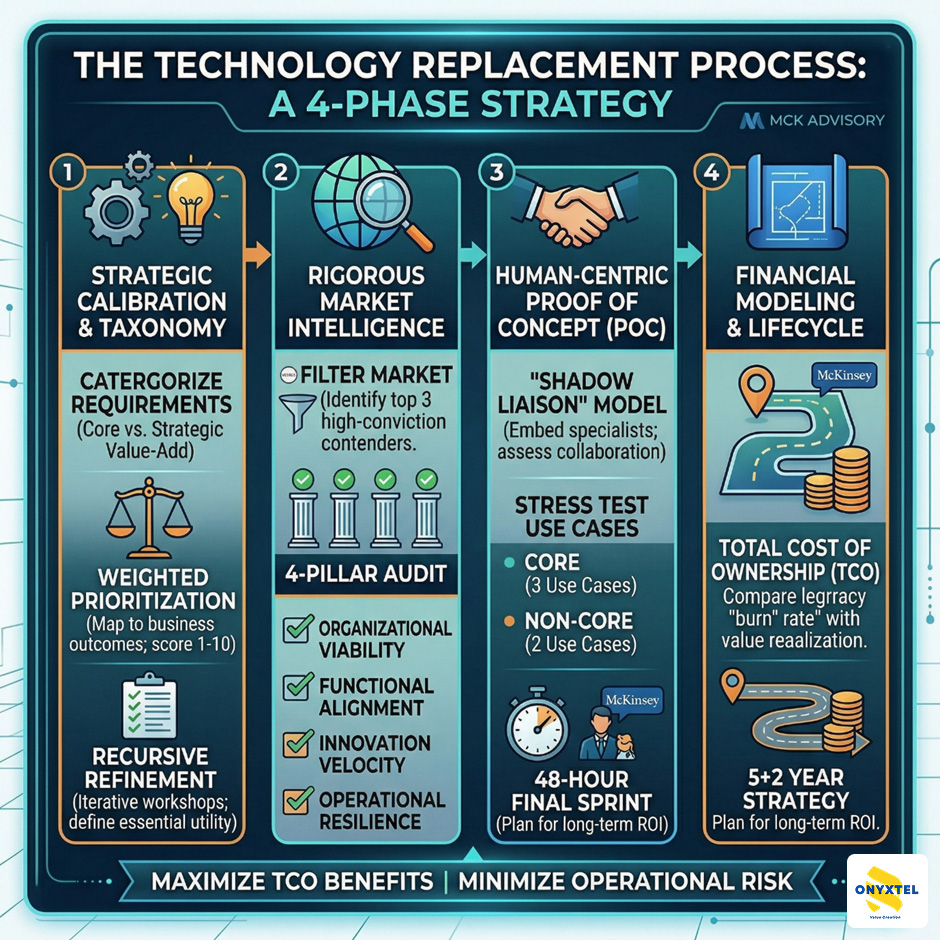
Phase I: Strategic Calibration & Taxonomy
Before engaging the market, we define the “North Star” for the replacement. We categorize requirements to ensure the final selection is lean and purpose-built.
- Capability Categorization: We bifurcate requirements into Non-Negotiable Core (mission-critical) and Strategic Value-Add (non-core).
- Weighted Prioritization: Every capability is mapped to a specific business outcome and assigned a Weighted Priority Score (1–10). This allows us to quantify the “Utility Gap” in current versus future states.
- Recursive Refinement: We conduct iterative workshops to “draw the line” between essential utility and unnecessary complexity, ensuring we don’t pay for features that don’t drive business KPIs.
Phase II: Rigorous Market Intelligence
With a defined framework, we filter the marketplace to identify the top three high-conviction contenders.
The “4-Pillar” Vendor Audit
We utilize a standardized questionnaire to evaluate the Top 3 Solutions across four critical dimensions:
- Organizational Viability: Vendor health, R&D spend, and referenceability within your specific industry vertical.
- Functional Alignment: A delta analysis of how the solution maps to the pre-defined Core vs. Non-Core requirements.
- Innovation Velocity: Analysis of the 3–5 year product roadmap to ensure the platform won’t be obsolete mid-cycle.
- Operational Resilience: Evaluating the support ecosystem—implementation methodology, change request (CR) agility, and hardware lifecycle management.
Phase III: The Human-Centric Proof of Concept (POC)
We move from “paper evaluations” to a 4–5 week high-fidelity simulation. This phase is designed to test both technical performance and cultural fit.
- The “Shadow Liaison” Model: We embed one of your internal specialists with each vendor. This provides “ethnographic” insight into the vendor’s responsiveness, technical depth, and collaborative transparency.
- Use Case Stress Testing: * Core (3 Use Cases): Deep validation of mission-critical workflows.
- Non-Core (2 Use Cases): Exploration of “Good-to-Have” features to assess future upside.
- The 48-Hour Final Sprint: A structured 2-day finale including 3 hours of live demos and 2 hours of “Dialogue Sessions” where vendor and enterprise users can have an open discussion on the solution and other value-adds & constraints that can be offered and attended to via deep collaboration.
Phase IV: Financial Modeling & Long-Term Lifecycle
A good replacement plan focuses on the Total Cost of Ownership (TCO), comparing the “Burn Rate” of the legacy system against the “Value Realization” of the new platform.
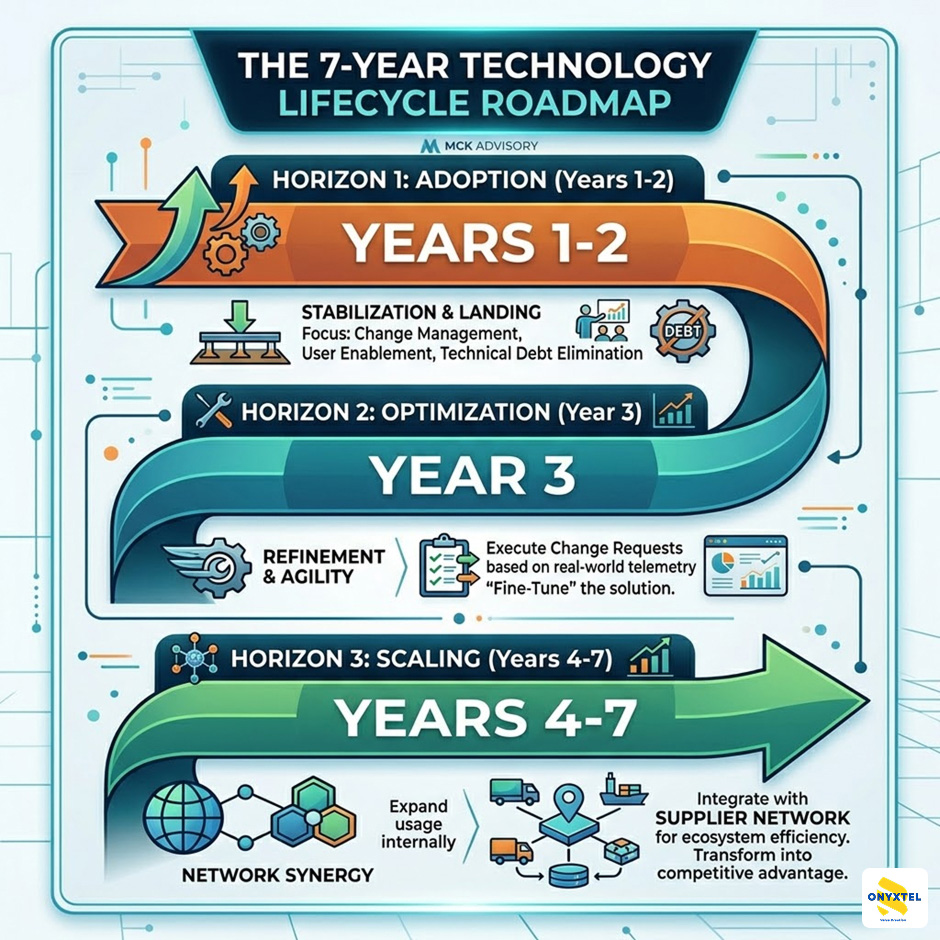
The 5+2 Year Lifecycle Strategy
We evaluate the investment over a 7-year horizon to ensure long-term ROI:
| Horizon | Strategic Focus | Tactical Execution |
| Years 1–2: Adoption | Stabilization & Landing | Focus on change management, user enablement, and technical debt elimination. |
| Year 3: Optimization | Refinement & Agility | Executing change requests based on real-world telemetry to “fine-tune” the solution. |
| Years 4–7: Scaling | Network Synergy | Expanding usage across the organization and integrating the platform with the supplier network for ecosystem-wide efficiency. |
Strategic Recommendation By shifting the focus from upfront licensing & hardware costs to long-term operational utility, this plan ensures the enterprise doesn’t just replace a tool, but upgrades its core capability. The inclusion of the “Supplier Network” synergy in Year 4+ transforms the technology from a cost center into a competitive advantage.