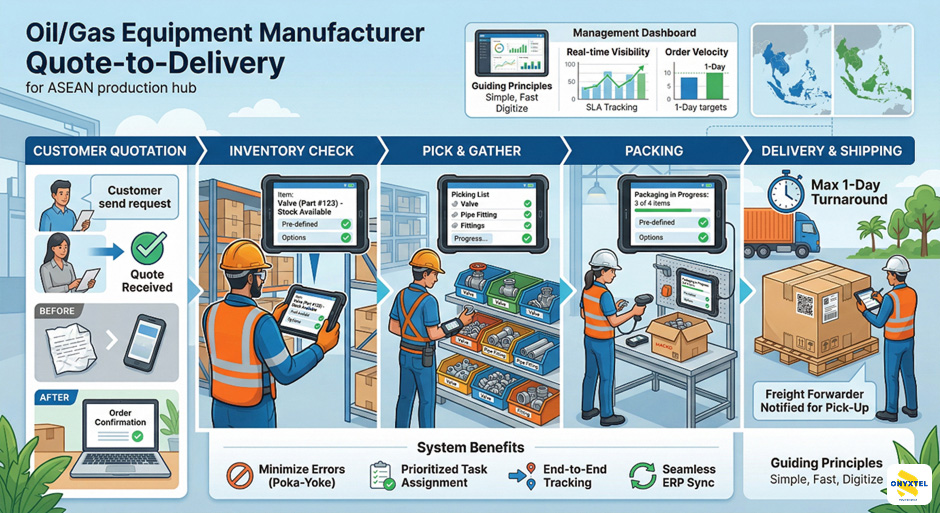
In the high-stakes Oil & Gas equipment sector, the traditional “Quote-to-Delivery” cycle is often plagued by paper-based silos, manual data re-entry, and a lack of floor-level visibility. In our ASEAN production hub, these inefficiencies directly challenged our goal of a one-business-day turnaround. To bridge this gap, we implemented a lean-led digital orchestration layer designed to accelerate throughput without over-complicating the operator’s workflow.
The Lean Approach: “Digitize the Flow”
Our guiding principle anchors on simplicity. In lean terms, any movement of information that does not result in a shipped part is “waste.” We mapped the value stream from quotation confirmation through to freight pick-up, identifying the hand-offs where orders typically stalled.
The solution moved away from a “pull” system—where workers check for work—to an automated “push” system. By compartmentalizing the workflow by role (Picker, Packer, Shipper), we ensured that each specialist receives a high-priority digital “pulse” on a ruggedized tablet the moment the preceding task is completed.
Operational Mechanics
To maintain a 24-hour velocity, we focused on three technical pillars:
- Error-Proofing: We replaced free-text entries with pre-defined, logic-based options to select (e.g., “Stock Available” vs. “Lead-time: 7 Days”). This ensures data integrity at the source; a task cannot be submitted until all critical parameters are selected and validated.
- Role-Based Priority Queues: Tasks are pushed to tablets based on urgency and a first-come-first-serve (FCFS) logic. This eliminates “cherry-picking” of easy tasks and keeps the oldest orders moving toward the shipping dock.
- Real-Time Tactical Visibility: Rather than waiting for end-of-shift reports, management utilizes a live dashboard. This “single pane digital dashboard” allows us to identify bottlenecks in real-time—if an order is stalled in “Packing,” we can reallocate resources immediately to clear the logjam.
The Roadmap: Toward ERP Synchronicity
The immediate win is operational speed. However, the long-term value lies in our integration roadmap. By formatting floor-data into batch-upload templates for the corporate ERP, we ensure that the “physical” world of the warehouse and the “financial” world of the headquarters are synchronized within the same business day. This lean-digital hybrid approach doesn’t just move parts faster; it creates a scalable, transparent, and highly responsive supply chain.