

Executive Summary
Modern retail faces a dual challenge: addressing growing consumer demand for climate action while sustaining commercial growth in highly competitive markets. This whitepaper presents a strategic blueprint for sustainability-focused consumption programs that harmonize these objectives. By leveraging transparent product carbon foot print, businesses can transform sustainability from a regulatory obligation into a powerful tool for customer engagement. When organizations establish structures that reward consumers with personalized incentives for choosing lower-carbon items, they unlock a self-sustaining marketing ecosystem. Merchants gain access to high-affinity consumer segments and high-efficiency, performance-based advertising channels, demonstrating that enterprise decarbonization can actively accelerate top-line revenue growth and build long-term brand loyalty.
The Shift in Consumer Priorities
A fundamental transformation is underway in consumer purchasing behavior across the globe. Rakuten market research establishes that 45% of consumers in the Asia-Pacific (APAC) region consider eco-friendly product manufacturing and packaging a vital purchasing criterion. This behavioral shift is spearheaded by younger demographics, with 56% of Gen Z and 59% of Millennials actively taking sustainability-influenced actions when making transactions. Furthermore, a PwC UK study indicates that consumers are willing to pay a 9.7% sustainability premium, even amidst broader inflation and cost-of-living concerns.
Global management consulting firms corroborate this shifting paradigm with data-backed market analysis:
- McKinsey & Co. (February 2023): In a joint multi-year longitudinal study with NielsenIQ titled “Consumers Care About Sustainability—and Back It With Their Wallets,” tracking five years of US consumer spending data, researchers revealed that products making ESG-related claims averaged a 28% cumulative growth rate, significantly outperforming conventional products, which stood at 20%.
- Boston Consulting Group (BCG / June 2023): Published in their global consumer sentiment study, “Our Green Future: The Sustainable Consumer Is Out There,” BCG’s research indicates that 70% of consumers are motivated to adopt sustainable consumption options when the purchasing journey actively minimizes friction and explicitly demonstrates individual, immediate, or environmental value.
Program Framework: Standardized Carbon Footprint and Behavioral Incentives
To bridge the gap between consumer intent and action, enterprises can integrate transparent environmental metrics directly into existing loyalty applications. This approach relies on a credible data layer and structured behavioral rewards.
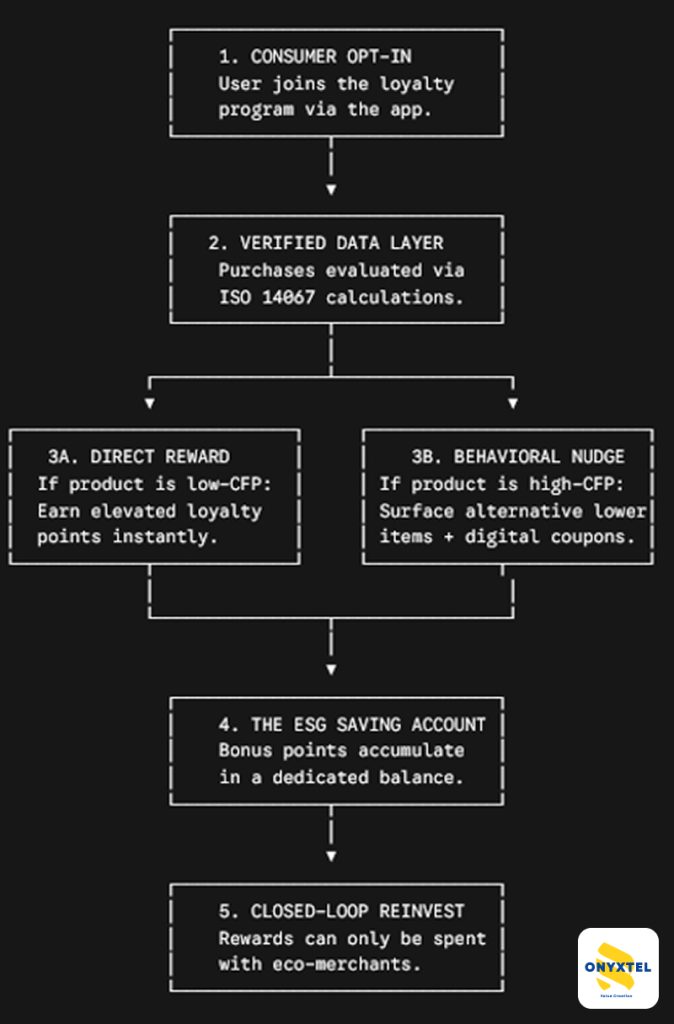
1. Verification via Standardized Carbon Quantifying
When a consumer opts into a sustainability program, their purchases are evaluated against verified product lifecycles. To eliminate risks associated with greenwashing and maintain rigorous transparency, emissions calculations must align with ISO 14067—the international standard establishing strict requirements for quantifying and reporting the Carbon Footprint of a Product (CFP). Utilizing datasets verified by accredited third-party laboratories ensures that baseline comparisons remain objective and scientifically sound.
2. Behavioral Incentives & Structured Rewards
If an item is verified as a lower-carbon alternative within its category, the consumer is awarded higher loyalty points to incentivize the choice. Conversely, when conventional, high-carbon items are selected, the platform can dynamically surface alternative product suggestions with lower carbon footprints, allowing consumers to educate themselves on better options. These suggestions can be paired with time-bound digital coupons to guide future purchasing intent.
To sustain this behavior, programs can introduce a dedicated ESG Saving Account within the loyalty ecosystem. Every time a consumer redeems a sustainability-focused coupon or purchases a verified low-carbon product, extra points are funneled into this specialized balance. These accumulated rewards are restricted for use exclusively on sustainable products and services, sealing a climate-positive consumption loop.
Global Market Proof Points
Integrating environmental parameters into loyalty structures is a proven, globally scalable mechanism:
- Southeast Asia Example (2022–Present): Regional super-apps such as Grab (via its GrabForGood framework) and GoTo Group (Gojek) in Singapore and Indonesia successfully integrated carbon-offsetting choices and green delivery variations seamlessly into consumer checkout flows. Consumers opting into these micro-actions or consistently selecting low-emission transit alternatives are awarded bonus corporate loyalty points redeemable across extensive food and e-commerce merchant networks.
- Europe/US Example (2021–Present): Major Western European retail conglomerates, including Migros (M-Check) in Switzerland and Carrefour in France, have successfully deployed integrated digital carbon footprint trackers inside their customer loyalty smartphone applications. Consumers receive a transaction-level summary of their grocery cart’s environmental impact alongside targeted loyalty point boosts when replacing high-emission items with verified plant-based or locally sourced product alternatives.
Ultimately, by aligning with consumer sustainability inclinations, organizations can create a full circle of positive reinforcement. Bringing data-driven awareness and behavioral empowerment to consumers—while introducing a network of sustainability-focused merchants into the matrix, establishing a resilient, high-affinity ecosystem where like-minded consumers and providers collectively drive green growth.