

If traditional AI was a librarian waiting for a question. Agentic AI is a tactical, rapid deployment unit that executes the mission. Microsoft’s 2025 research highlights this shift, noting that 82% of organizations plan to leverage AI-driven digital labor within the next year, a move from simple chatbots to autonomous process orchestration.
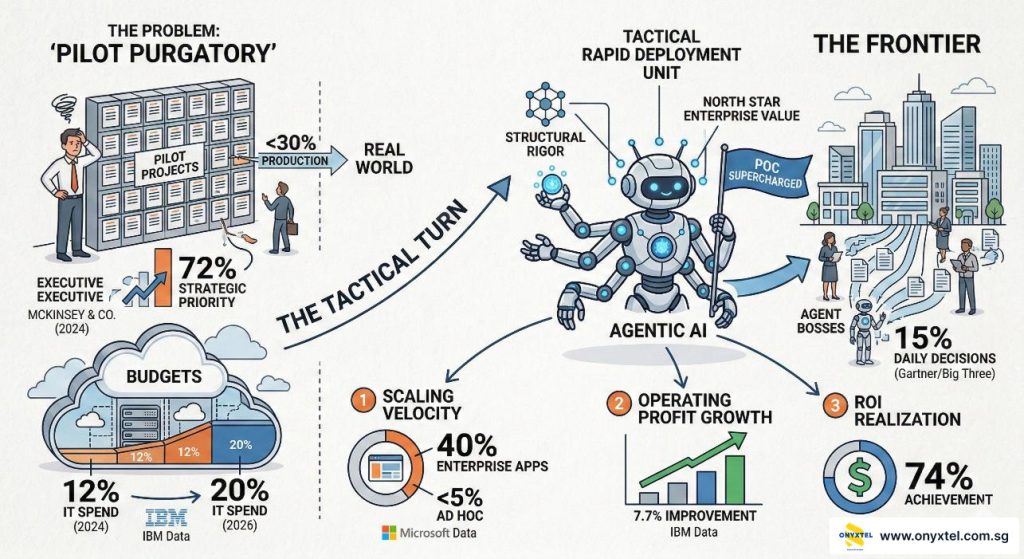
In the winter of 2024, a strange consensus emerged among the world’s most powerful executives. According to McKinsey, 72% of them declared Artificial Intelligence not just a “tech project,” but their top strategic priority. We like to think that when the giants of industry move in unison, the world changes instantly. But it didn’t. Instead, we entered what insiders call “Pilot Purgatory”.
It is a staggering statistic: while everyone is starting AI projects, fewer than 30% ever reach the “real world” of production. Imagine if 70% of the planes built by Boeing never actually took off. We would call that a catastrophe. In the corporate world, we call it a “learning phase”.
But why does this happen? The answer isn’t that the technology is broken; it’s a framing problem. Most transformation failures stem from a single, quiet mistake: misaligned problem definition. We are so enamored with the solution that we forget to interrogate the problem.
The Rise of the Tactical Rapid Deployment Unit
There is, however, a new thread in this narrative: Agentic AI. If traditional AI was a librarian waiting for a question, Agentic AI is a tactical, rapid-deployment unit that executes the mission.
Microsoft’s 2025 research highlights this shift, noting that 82% of organizations plan to leverage AI-driven digital labor within the next year. This is a move from simple chatbots to autonomous process orchestrators. By 2026, the stakes will be even higher. Gartner predicts that 15% of daily work decisions will be made autonomously through these agentic systems.
To break through “pilot purgatory,” you must supercharge your Proof of Concept (POC) with these agents. You define the “perimeter” of the work and the desired outcome, allowing the team to stand up a POC with speed and rigor.
The Infrastructure of Success
The difference between a multi-million-dollar mistake and a successful transformation isn’t the size of the budget; it’s the structured rigor of the approach. Consider the data:
- Google Cloud reports that “agentic early adopters” see a significant ROI advantage, with 88% reporting positive returns compared to 74% of the broader market.
- IBM points out that while generic pilots often stall, AI-enabled workflows have tripled in profit contribution, improving operating profits by 7.7% in 2024.
- Microsoft found that “Frontier Firms”—those moving past experimentation—are 2.5 times faster at scaling than their peers.
Success is not a happy accident. It requires a relentless focus on the “North Star” of enterprise value creation. By 2026, IBM predicts AI investment will rise to 20% of total IT expenditure.
The question is no longer “what can AI do?” but “what specific friction point can we remove to create an explosion of value?”.