

AI is the engine. But digitization is the fuel. And without the fuel, even the most sophisticated engine is just a very expensive paperweight going nowhere.
We have a habit of looking at progress as a series of sudden, jagged leaps. We see the arrival of Artificial Intelligence and imagine it as a bolt of lightning—a singular event that instantly transforms a sluggish bureaucracy into a lean, thinking machine. But if you look closer at how organizations actually succeed, you’ll find that the “lightning bolt” theory is almost always wrong.
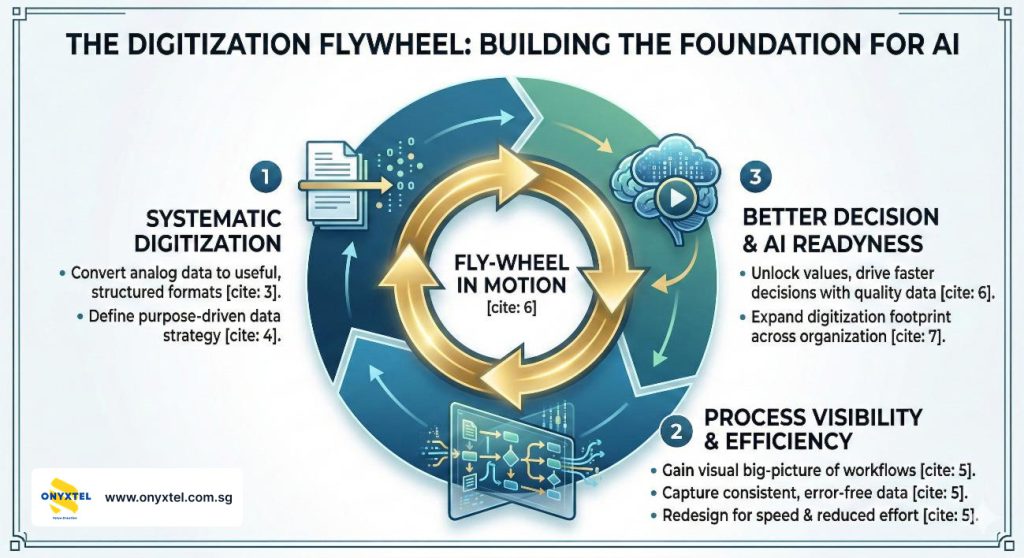
The Purpose-Driven Blueprint
Think of digitization not as a tech project, but as a systematic act of translation. You are taking the messy, unstructured reality of your daily operations and translating them into a language a machine can understand. As the data assembles into useful formats, something curious happens: you stop asking “What data do we have?” and start asking “What do we want to solve?”
This is what I call purpose-driven strategy. According to Accenture’s 2024 research, nearly half of CXOs (48%) admitted their organizations lacked the high-quality data necessary to actually operationalize AI. They had the “brain” (the AI), but they hadn’t given it a “memory” (the data) worth using. Digitization is the process of deciding which memories matter.
Visibility Before Velocity
As an organization embarks on this journey, it begins to see itself for the first time. You build a visual, big-picture view of how workflows interact. You aren’t just digitizing to “go faster”—though McKinsey’s 2026 State of Organizations report notes that leaders expect exponential productivity gains from this—you are digitizing to capture data in a consistent, error-free manner.
When you remove the human error from the data entry, you aren’t just cleaning up a spreadsheet; you are building trust. PwC’s 2026 AI Business Predictions highlight that the “disciplined march to value” begins only when leadership picks specific workflows to redesign. You cannot redesign what you cannot see.
The Flywheel Effect
When the “wheel of digitization” is finally in motion, the organization gains a sudden, startling visibility. Quality data accumulates. Decisions that once took weeks of “gut feel” now happen in seconds based on evidence. This is the moment the footprint expands.
The data strategy and the digitization footprint feed each other, creating a roadmap that unlocks value across the entire enterprise. By 2026, the divide will be clear: Accenture notes that 71% of leaders now rank investment in digital tools as their top strategy for managing change.
AI is the engine. But digitization? Digitization is the fuel. And without the fuel, even the most sophisticated engine is just a very expensive paperweight.