
A Strategic Blueprint for AI-Driven Enterprise Transformation
Enterprises today face a defining inflection point: how to move AI from isolated experimentation into the fabric of how they operate, compete, and grow. The urgency is no longer theoretical. 78% of companies are already using AI in 2025, up from 55% in 2023, yet only 1% have achieved mature deployment. The gap between adoption and impact is where competitive advantage is either won or permanently surrendered. The HIGH Framework offers a clear, workforce-centric answer — by elevating AI from a software tool to a Digital Worker, we close the integration gap between human capability and machine efficiency, unlocking a new frontier of enterprise performance.
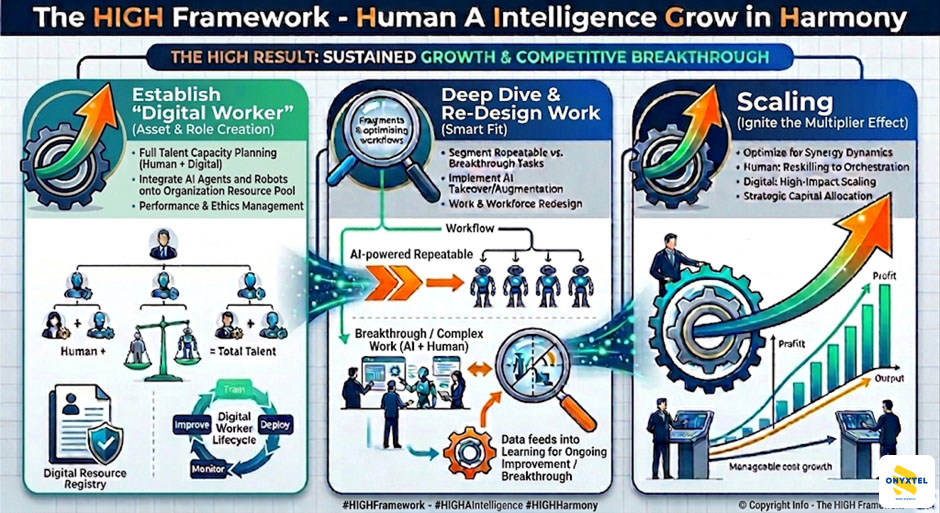
1. Digital Worker as Part of Total Talent Planning The most important shift required is conceptual, not technological. When AI agents and robots are treated as genuine workforce assets — with defined lifecycles encompassing onboarding, performance management, and capability advancement — the entire organization orients differently around them. Leading organizations are increasingly integrating Digital Workers alongside their human workforce, deliberately enabling people to focus on higher-value activities such as governance, compliance, and growth strategy.
From a CFO and CIO perspective, this repositioning reframes AI investment from a pure operating expense into a measurable, value-generating asset. Workforce planning evolves accordingly, with HR and operations teams managing Total Talent Capacity — a combined view of human and digital contributors — rather than headcount alone. This is the foundation upon which scalable, high-performing hybrid organizations are built.
2. Work Redesign: Compartmentalize, Optimize, Re-Design Enduring performance gains demand more than task automation. They require deliberate work segmentation:
- Lower-Value, Repeatable Work → Digital Workers take over, driving marginal costs toward zero across functions like Level 1 support and transactional operations. McKinsey estimates generative AI could reduce human-serviced customer contacts by up to 50% in banking, telecommunications, and utilities.
- High-Impact, Complex Work → Digital Workers augment human expertise, accelerating breakthroughs in R&D, material science, and cybersecurity. McKinsey projects a potential $4.4 trillion annual productivity boost — approximately 4% of global GDP — from AI applied systematically across corporate use cases.
- Human-Centric Work → Digital Workers absorb administrative and transactional burden, freeing human talent for judgment, creativity, and high-stakes decision-making. McKinsey finds employees are reclaiming 20–30% of their working hours for higher-value activities.
Yet segmentation alone is insufficient. The true bottleneck in most organizations is outdated workflow design and fragmented data infrastructure. McKinsey’s research reveals AI high performers are nearly three times more likely to have fundamentally redesigned individual workflows — and this deliberate redesign ranks among the strongest predictors of meaningful business impact. When processes are clean and data foundations are sound, Digital Workers become genuine force multipliers.
3. Scaling for Competitive Advantage Scaling separates a competent transformation from genuine market leadership — and it remains the industry’s most elusive challenge. Despite rising usage, only around one-third of organizations successfully scale AI across the enterprise. Those that break through compound three powerful dynamics:
- Feedback loops that continuously refine business outcomes as Digital Workers generate operational data at scale, creating a self-improving performance engine.
- Workforce evolution that transitions employees from task executors to strategic orchestrators of AI. Gartner predicts at least 15% of day-to-day work decisions will be made autonomously through agentic AI by 2028 — a signal that orchestration capability will soon be a core leadership competency.
- Non-linear output growth that compounds for those who move with focus and intent. BCG research shows AI leaders expect 60% higher revenue growth and nearly 50% greater cost reductions by 2027. Critically, companies prioritizing depth over breadth — focusing on an average of 3.5 use cases versus 6.1 for others — anticipate 2.1 times greater ROI. Focus, not volume, is the scaling advantage.
4. Governance, Review and Tuning (GRT) No transformation of this magnitude sustains itself without robust guardrails. GRT serves as both the ethical compass and the operational feedback system that keeps transformation on course. BCG’s research underscores that two-thirds of effort and resources must be directed at people-related capabilities — governance structures, cultural change, and workforce enablement — with technology comprising only the remaining third.
Regular reviews validate progress, surface economic value unlocked, and expose gaps before they compound. Tuning cycles drive continuous optimization — adjusting design, reallocating resources, and refining Digital Worker performance based on empirical data. With Gartner projecting that 40% of enterprise applications will be integrated with task-specific AI agents by end of 2026, the governance capability to oversee, audit, and course-correct an expanding digital workforce is an immediate strategic imperative.Summary: The HIGH Framework offers compelling mid-term outcome. But the prize belongs to enterprises that approach this not as a technology deployment, but as a fundamental reimagination of how work gets done & enterprise values are created — building an organization where Humans and Digital Workers grow in harmony, each making the other more powerful than either could be alone, supporting by guardrails and ethics codes that observe and nudge for the better.